
Will AI Make Good Grades Less Valuable? The Skills Your Child Will Need in 2035
31 Oct 2026
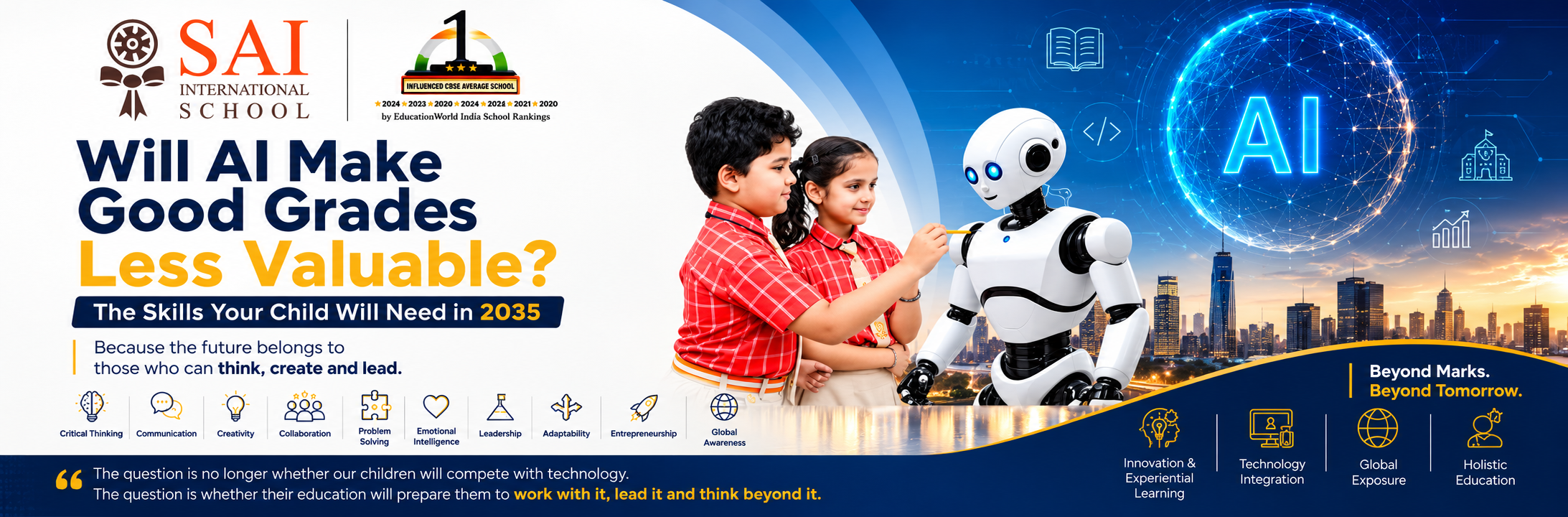
Artificial Intelligence is changing the way we live, work and learn.
Machines can already remember vast amounts of information, calculate complex problems, search for answers, generate content and perform tasks that once required hours of human effort. As automation continues to evolve, one question becomes increasingly important:
If machines can increasingly remember, calculate, search and even write—what should schools actually teach?
The answer may lie beyond textbooks, examinations and grades.
From Knowing Answers to Knowing What to Do With Them
Good grades will always have value. They demonstrate discipline, knowledge and academic commitment. But in a world where information is available at the click of a button, knowing information is only one part of being capable.
The children who thrive in the future will need to know how to question information, make decisions, work with others and respond when there is no straightforward answer.
This makes 21st-century skills increasingly important:
- Critical thinking questioning, analysing and evaluating information rather than accepting it at face value.
- Communication expressing ideas clearly, listening actively and connecting with different audiences.
- Creativity imagining possibilities and developing original ideas.
- Collaboration working effectively with people who may have different perspectives and strengths.
- Problem-solving approaching unfamiliar challenges with logic, curiosity and persistence.
- Emotional intelligence understanding emotions, building relationships and responding with empathy.
- Leadership taking initiative, making responsible decisions and inspiring others.
- Adaptability remaining confident and capable when circumstances, technologies and expectations change.
- Entrepreneurship identifying opportunities, taking calculated risks and turning ideas into action.
- Global awareness understanding different cultures, perspectives and the interconnected world.
These are not skills that can simply be memorised before an examination. They develop through experience.
So, What Should a Modern School Look Like?
The future of education is not about replacing traditional learning with technology. It is about creating an environment where technology, knowledge and human abilities complement one another.
A modern school needs to give children opportunities to learn by doing, question by exploring and grow by taking responsibility.
This could mean classrooms where technology is used as a tool for research and creation rather than merely consumption. It could mean experiential learning where students design, build, experiment, perform and solve real-world problems. It could mean leadership opportunities, collaborative projects, innovation challenges and meaningful exposure to the world beyond the school campus.
It also means giving children the confidence to make mistakes, reflect on them and try again.
Because adaptability cannot be taught through a worksheet.
Preparing Children for a World We Cannot Fully Predict
We do not know exactly what jobs will exist in 2035. Some professions may change dramatically, while entirely new careers may emerge.
What we can prepare children for is change itself.
A strong future-ready education therefore does not focus only on what a child knows today. It develops the ability to keep learning tomorrow.
This is where holistic education becomes particularly significant. Academic knowledge remains an essential foundation, but it must work alongside creativity, communication, technology, leadership, collaboration, global exposure and personal development.
The goal is not to raise children who can simply compete for marks.
It is to nurture young people who can think independently, work collaboratively, adapt confidently and create meaningful solutions.
Beyond Grades
Perhaps the most important question for parents is not simply:
What grades will my child get?
but:
What will my child be able to do with what they learn?
As AI becomes better at performing tasks that once distinguished human capability, qualities such as curiosity, judgement, empathy, creativity and courage may become even more valuable.
The best education will not prepare children to compete against technology.
It will prepare them to understand it, question it, use it responsibly—and ultimately, remain distinctly human.
At SAI International School, education focuses on nurturing these qualities to help students work with technology, lead with confidence and think beyond it.
The question is no longer whether our children will compete with technology. The question is whether their education will prepare them to work with it, lead it and think beyond it.
Photo Highlights